
As organizations move toward S/4HANA, finance leaders are under increasing pressure to modernize operations while keeping ERP environments stable, compliant, and ready for the future.
These challenges were the focus of a recent webinar hosted by SSON Digital, in collaboration with Basware, which examined how accounts payable can support ERP transformation rather than become a source of risk.
The session was moderated by Bethany Brown, Editor and Digital Content Manager at SSON Digital, and featured insights from Chris Foti, Director of Partnerships and Alliances at Basware, and Anand Singh, Head of Process Transformation and Integration at Heidelberg Materials.
Live polling during the session revealed just how many organizations are still navigating this transition.
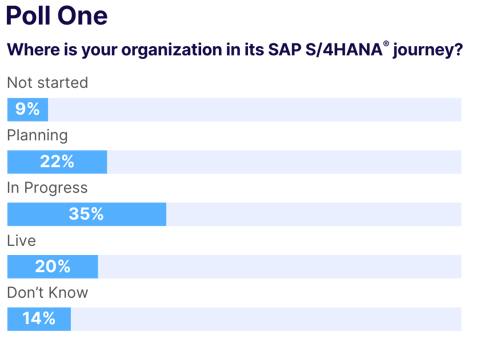
While 20% of attendees reported already being live on S/4HANA, the largest group (35%) said their programs are currently in progress. Another 22% are still in the planning stage, highlighting that for many organizations the transformation journey is still actively unfolding.
Why AP deserves a seat at the table
One of the strongest messages from the discussion was that ERP transformation is not just a technology project. Decisions made during an S/4HANA program directly shape finance operations, compliance posture, and the ability to scale automation over time.
Accounts payable, in particular, plays a critical role. When AP is treated as a downstream function, organizations risk reintroducing complexity through customization and manual workarounds. When it is addressed early, AP can help support standardization, efficiency, and long-term resilience.
This challenge was reflected in the audience poll results.
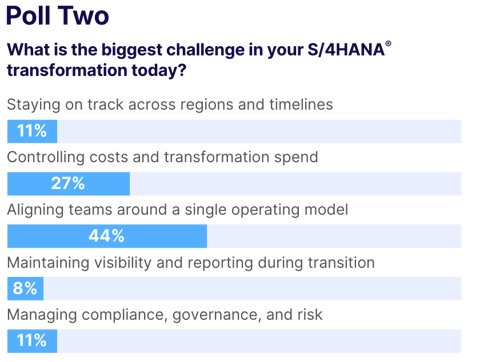
When asked about the biggest hurdle in S/4HANA transformation today, 44% of respondents said aligning teams around a single operating model was their top concern. Cost control followed at 27%, while other respondents pointed to issues such as governance, compliance, and maintaining visibility during transition.
Together, these results highlight that the most difficult aspects of transformation are often organizational rather than technical.
Clean core does not mean limited capability
The webinar emphasized that maintaining a clean ERP core does not require sacrificing AP functionality. Instead, handling invoice complexity outside the core allows organizations to reduce customization while still supporting automation, compliance, and visibility.
This approach helps organizations manage real-world challenges such as local regulatory requirements, diverse invoice formats, and high transaction volumes, while keeping the ERP foundation simpler and easier to maintain. It also positions finance teams to take advantage of future automation and AI capabilities.
Practical lessons from large-scale transformation
Drawing on experience from a multi-country transformation, the session highlighted several practical lessons that resonated with attendees:
- Involve business stakeholders early, not just IT.
- Align finance, procurement, and IT from the start.
- Use standard templates and phased rollouts to manage complexity.
- Clearly distinguish legal requirements from legacy practices.
These practices helped reduce disruption during deployment and supported scalability across regions.
Automation, compliance, and visibility
Automation was positioned as essential for both efficiency and control. Reducing manual invoice handling, automating approvals, and managing exceptions through defined rules can strengthen compliance while freeing finance teams to focus on higher-value work.
Improved visibility was another key benefit. With clearer insight into invoice status, supplier behavior, and recurring exceptions, organizations are better equipped to address root causes rather than repeatedly fixing the same issues.
Key takeaway
The session reinforced that AP should be treated as a strategic component of any S/4HANA transformation. A clean core approach, combined with intelligent invoice processing, can help organizations reduce risk, improve efficiency, and build a stronger foundation for future innovation.
Watch the webinar on demand
To hear the full discussion and explore these insights in more detail, watch the webinar on demand and learn how finance leaders are approaching clean core strategies and AP modernization as part of their S/4HANA journeys.