
The finance software industry has reached a rare consensus. AI in finance has to be transparent and explainable enough for a user to clearly see how each decision was reached. Finance’s caution around AI in the recent past was understandable. With plenty of hype to sort from substance, and a wave of tools that gave answers without showing the process or reasoning behind them, it was the sensible response. Putting the model’s reasoning on show answers that worry: a team can see how each decision was reached. That was real progress.
But for the finance leaders I speak with, transparency answers only half the question. Though seeing how an AI reached a decision is necessary, it is not the same as deciding how far to let that AI go, or knowing who is accountable when it acts. A team can watch every step a model takes and still have no framework for how much authority to hand it, or where the buck stops. Closing that gap is what Governed Autonomy is built to do.
Why transparency became the price of entry
Eighteen months ago, the AI conversation in finance was about raw capability. Could the model code the invoice? Match the purchase order? Catch the duplicate before it was paid? Today the answer to all three is yes. And so, the conversation has moved on. It is now about trust.
Analysts increasingly describe explainability, human oversight, and embedded controls as baseline expectations rather than differentiators. The market has settled on a simple dividing line: whether or not an AI can show its reasoning. The logic follows: if your AI cannot show its reasoning, finance teams will not put it anywhere near a payment run.
The fear underneath the demand for transparency is real. An AI that acts without visible reasoning is unexplained exposure, every automated decision a potential audit finding waiting to surface. Regulation is moving the same way; frameworks like the EU AI Act expect risk to be assessed and decisions to be traceable. This is the market’s way of saying: show your work.
That shift is healthy. It is also, increasingly, the price of entry. But when every vendor promises transparency, it stops being a differentiator. The harder question is what you build on top of transparency. That is where most vendors fall silent.
How far should you let AI go?
Transparency answers one question: what did the AI just do? The decision a finance team actually has to make is a different one. Given that you can see how the model reasons, how much of the work should it run on its own, and where should a human stay in the loop? That second question is where adoption stalls. Not the seeing, but the deciding.
Governed Autonomy is how we answer it. It is an architecture, not a feature. Put simply, it is AI with a point of view about what not to do. It is not autonomy for its own sake. It is a way of designing AI so the customer, not the vendor and not the model, sets how far automation goes.
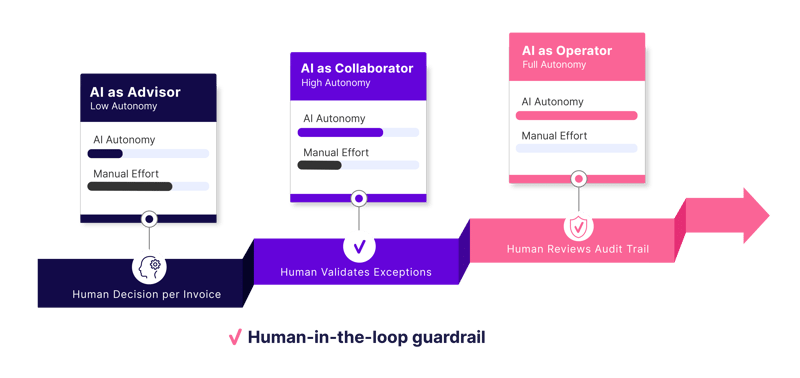
In practice, that means a deliberate progression. Picture it across a single task like invoice coding:
- As an advisor: The AI suggests the account and cost center, and a clerk confirms each one. The value here is not speed yet. It is that the AI surfaces what your team would have missed and learns your patterns, while a person stays fully in the loop.
- As a collaborator: It codes the straightforward invoices itself and routes only the low-confidence ones to a person. This is where touchless rates climb and people stop doing data entry, as long as the AI knows where the lines are.
- As an operator: It codes the full population while a controller reviews the exceptions and the trail. Human attention moves to the exceptions and the judgment calls, and a function running here often looks calmer than its peers, not busier.
What changes between those stages is not the AI’s capability. It is how much authority the customer has granted it, and that authority is set deliberately. Each stage runs on confidence thresholds the customer controls: above the threshold, the AI acts on its own; below it, it proposes a value and routes the decision to a person. The threshold moves as trust is earned, not before. It only works if the AI knows where the lines are; without that, acting on the routine is just fast mistakes.
That is the part that matters. You start where you are comfortable, and you move only as the evidence earns it. Nobody dictates the pace, and you can hold a process at the advisor stage for as long as your risk appetite requires. You set how far it goes, per process, per risk tier. That control is what makes the autonomy governed.
Accountability stays human: autonomy you can defend
Here is the principle I keep returning to: autonomy without accountability is a liability.
Defensibility is the part finance cares about most. The barrier to AI in finance was never whether the technology could act. It was whether a finance leader could answer for what it did. A vendor that cannot show you why the AI did what it did is not offering Governed Autonomy. It is offering good marketing wrapped around an AI that cannot explain itself.
Every CFO is now fielding versions of the same question from their board: can you defend the decisions AI made, and can you prove its impact in production rather than in a pilot deck? Governed Autonomy is what lets a finance leader answer yes, without flinching.
So, every decision Basware’s AI makes is Auditable AI: logged, traceable, and defensible to a regulator, auditor, or tax authority. Governance also sets hard limits on what the AI may touch at all: it will not alter a tax ID, a clearance stamp, or a QR code on a compliant invoice, at any level of autonomy. The audit trail is complete whether the AI acted as advisor or operator. Because compliance is built into the platform rather than bolted on, that defensibility holds across jurisdictions: immutable archives, certified per country, with the trail on every AI decision retained for as long as an auditor might ask.
In Practice: Avolta
“We can see exactly how many invoices were processed manually, how many steps there were at the click-level. With AI tools, we will get this visibility immediately, which also highlights the potential for further automation. You really need to invest in AI where you can see results straight away.”Tom Aussems, Global Tower Head Accounts Payable, Avolta
And as AI absorbs more of the volume, the human role does not shrink. It sharpens. People focus on the judgment only they should own: the exceptions, the supplier relationships, the decisions that carry real consequence.
What makes any of this credible at scale is the foundation beneath it. Basware’s AI is trained on the largest proprietary dataset in accounts payable: more than 2.5 billion invoices, over $10 trillion approved for payment, and 41 years of AP-specific learning. Most AI is trained only on what is correct, the good invoice, the clean entry. Ours learns from the rejected, the duplicate, the fraudulent, and the miscoded too, so it knows what wrong looks like. It carries out roughly one billion AI actions a year, more than 81% of them without human intervention. Not because anyone mandated that level of automation, but because customers became confident enough to allow it.
And it all sits inside one platform. Basware Invoice Lifecycle Management governs every invoice end to end, across every country and every ERP. That is what keeps the audit trail intact from the moment an invoice arrives to the moment it is archived, no matter how much of the work the AI is trusted to do.
What to look for next
Transparency was the right place for finance AI to start. It is not where the conversation should end. The vendors worth trusting are the ones who hand you the controls, and can prove every decision the AI makes, at every level of autonomy you choose. Autonomy and integrity were never a trade-off. The whole job is refusing to choose between them.
Want to know what separates AI that just follows orders from AI you can actually trust with a payment run? Learn what Governed Autonomy really means.