
Finance leaders are increasingly seeing the same issue crop up in accounts payable. Despite well-defined workflows and accurate reporting, friction is becoming more frequent. Supplier disputes escalate more often, invoices sit longer in approval queues, and month-end close takes progressively more effort due to repeated manual chasing of missing or inconsistent data.
Your spreadsheets are immaculate. Your processes are airtight, and your team is doing everything right. But something just isn’t clicking.
And then comes the quiet, nagging realization: the way you’re working right now is not sustainable.
Across finance teams, this moment is arriving sooner and more frequently. And it brings with it a slightly uncomfortable truth: the tools we’ve relied on for the last decade can’t carry us through the next.
The gap between ambition and reality
At the March 2026 SSON AP Automation Virtual Summit, I hosted a session designed to cut straight to the question on every finance leader’s mind: What does meaningful AI adoption actually look like in accounts payable?
I was joined by Tara Letourneau–Bal, Executive Director of Finance Client Services at University Health Network, and together we explored how organizations are moving beyond hype toward tangible results with agentic AI.
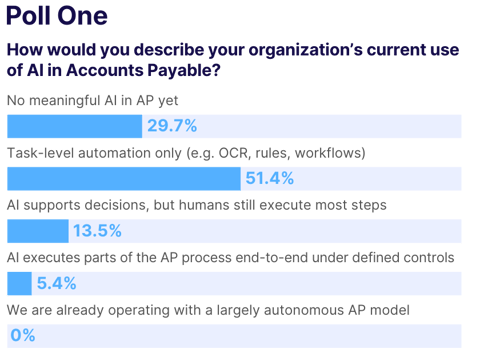
When our finance practitioner attendees reflected on their own AI use, the results were revealing. A clear majority reported their teams were focused on task-level automation (things like rules, OCR, and workflow improvements) while a significant portion admitted they had no meaningful AI in place. Largely autonomous AP processes? Not yet. From my conversations with AP leaders, this mirrors a broader pattern: ambition is high, experimentation is happening, but most teams are still operating in a world of helper tools rather than truly autonomous agents. What struck me in this session is how closely those responses match what I hear from AP leaders every week: plenty of enthusiasm for AI, but a clear insistence on control, clarity, and governance first.
Finance teams don’t want magic, they want certainty
Finance leaders were also asked what they would need before trusting a more autonomous AP model. The answers were telling. They weren’t looking for breakthroughs or the latest algorithm. They wanted confidence, control, and clarity…the same principles they rely on every day with their teams.
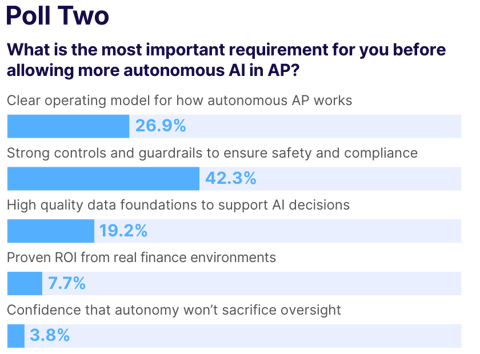
The data showed a clear hierarchy of priorities: leaders want guardrails, transparency, proven safety, clearly defined responsibilities, and predictable behavior. In other words, teams aren’t resisting autonomy, they’re simply waiting for autonomy that respects how their world actually works.
Make your agents colleagues, not concepts
Once you strip away the hype, agentic AI becomes surprisingly familiar. Rather than an abstract intelligence, it’s better to think of it as a digital colleague…one that can be onboarded, scoped, governed, and given measurable outcomes.
This digital team member also doesn’t mind repetition, and so can easily take some of the daily monotony off your physical team’s plate.
But, just like any new co-worker, it can’t arrive with unlimited authority. It earns it through boundaries, testing, transparency, and trust that grows only as fast as the team is ready for it. For many organizations, this simple reframing changes everything.
The quiet power of starting small
Real transformation rarely starts with sweeping reinvention. More often, it begins with a single, tightly defined problem, one small enough to manage, but painful enough to matter.
For one healthcare finance team, that problem was simple: 80% of invoices were manually keyed into the system. Hours every day were swallowed by typing, correcting, and re-typing. While the work was necessary, it was practically draining.
So, they tried something new. Not a full overhaul. Not a restructuring. Just one small step: letting an AI worker take over invoice ingestion and enrichment while the team supervised.
The results were immediate. Monotony disappeared, cycle time dropped, confidence grew. And energy returned to the team, the kind that comes when people are finally being used for their skills, not their keystrokes. Leadership didn’t celebrate the technology. They celebrated the relief.
Where the industry is heading, slowly, surely, and safely
The journey toward autonomous AP won’t be a dramatic leap. It won’t look like robots replacing roles or dashboards replacing judgment. It will look like this:
- Human-centered roles becoming more human.
- AI stepping into repetitive layers that were never meant for people.
- Governance becoming the backbone, not a bureaucratic barrier.
- Teams moving from manual tasks to meaningful work.
- Autonomy growing in measured, controlled increments.
Somewhere along the way, the shift becomes irreversible. Not because AI is perfect, but because the old way suddenly feels impossible to return to.
If this story sounds familiar…
If your team is feeling the strain of doing more with the same tools…
If your processes work on paper but crack under real-world volume…
If you’ve wondered whether AI could help but feared losing control…
Then you’re already standing at the same inflection point as countless AP leaders. The next step simply requires seeing what’s possible when autonomy is introduced the way finance actually works: carefully, transparently, and with purpose.
Discover how finance leaders are moving beyond automation and redefining work in accounts payable.
Watch the on-demand session: From Hype to High ROI: How Finance Teams Are Unlocking Real Value with Agentic AI